 My GeoNetwork catalogue
service
Provided by
Type of resources
Available actions
Topics
Keywords
Contact for the resource
Update frequencies
Service types
-
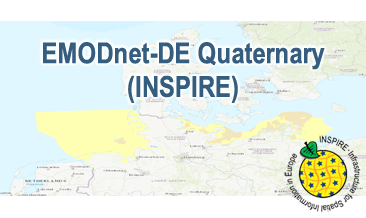
Compilation of the European Quaternary marine geology (section of Germany). The original map consists of data at highest available spatial resolution, map scale („multi-resolution“-concept) and data completeness vary depending on the project partner (as of 2019 April). Project partners are the national geological services of the participating countries. According to the Data Specification on Geology (D2.8.II.4_v3.0) the geological map (section of Germany) provides INSPIRE-compliant data. The WMS EMODnet-DE Quaternary (INSPIRE) contains layers of the geologic units (GE.GeologicUnit) displayed correspondingly to the INSPIRE portrayal rules. The geologic units are represented graphically by stratigraphy (GE.GeologicUnit.AgeOfRocks) and lithology (GE.GeologicUnit.Lithology). The portrayal of the lithology is defined by the first named rock. Via the getFeatureInfo request the user obtains detailed information on the lithology, stratigraphy (age) and genesis (event environment and event process).
-
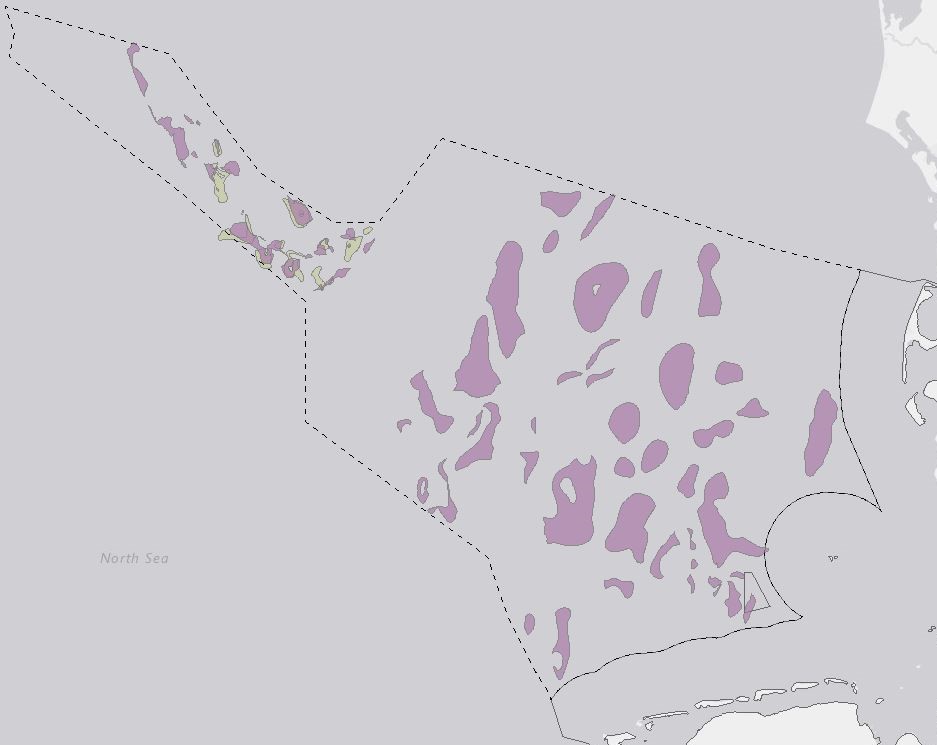
Storage of CO2 in deep geological formations is one possibility of reducing CO2 emissions from industry that are difficult to avoid. High-quality geological models and capacity estimates are crucial for the successful planning and implementation of safe storage projects. This study analyses the storage potential of the Middle Buntssandstein (Lower Triassic) and Lower to Middle Jurassic within the Exclusive Economic Zone (EEZ) of the German North Sea. Link https://geostor.cdrmare.de/
-
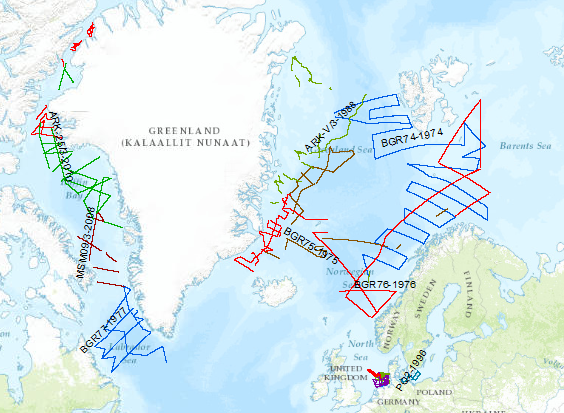
During the period from 1974 to 2018 various cruises from BGR acquired seismic lines worldwide. The aim of these marine expeditions was a detailed survey of the geological structure.
-
GNSS Pegelmonitoring der Bundesanstalt für Gewässerkunde. Inhalt sind alle relevanten Informationen zur Auswertung von GNSS-Beobachtungen aller GNSS-Stationen entlang der Deutschen Bucht, die einen Pegelbezug aufweisen. Dies beinhaltet neben den BfG eigenen Stationen auch sechs GREF-Stationen des Bundesamt fpr kartografie und Geodäsie (BKG). Neben Informationen zu den GNSS-Systemen werden auch aktuelle Höhendifferenzen zwischen den GNSS-Markern und den Pegelnullpunkten bereitgestellt. Die Stationen der BfG sind mit den Pegelanlagen fest verbunden (GNSS@tide gauge), während der Pegelbezug der sechs GREF Stationen im Rahmen einer Kooperation durch die WSV/BfG realisiert wird. BfG MapService 'KLIWAS_Projekt202', OGC:WMS 1.3.0
-
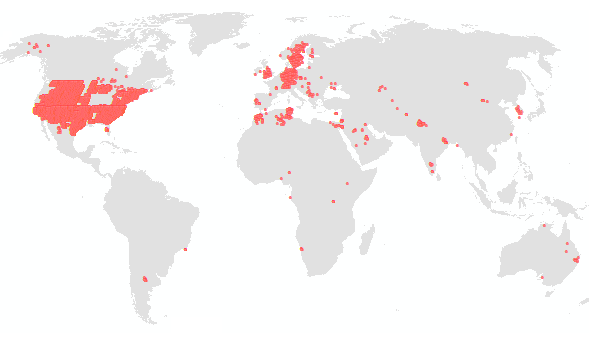
Considering water as the primary resource necessary for social life, agriculture, industry, and wealth, the importance of groundwater investigation is clear. Apart from many other pollutants, this work focusses on geogenic uranium (U) and radium (Ra), which both stand for natural radionuclides (NORM) that need to be considered frame of groundwater exploration and monitoring programmes due to their specific mobility and chemo-/radiotoxicity. As investigation of U and – to a lesser extent - Ra is done by an increasing number of scientific working groups, the global dataset is improving continuously. In order to give a summarized overview on available and recent literature, scientific papers, reports, and governmental documents have been reviewed for U-238 mass concentrations and Ra-226 and Ra-228 activity concentrations and collected in tables and global maps. Further natural isotopes of U and Ra have been rarely subject of investigation. The collected data were evaluated and interpreted in frame of an associated scientific publication (see citation). From the available data it can be concluded that high geogenic U occur mainly under oxidizing conditions and carbonate rich groundwater, which might be seen as indicator for elevated U concentrations. Certain geological formations, as for example sedimentary, granitic, and volcanic host rocks, promote high U concentrations in groundwater. For geogenic Ra, the search for definite indications proved difficult, since less clear correlation is given for any observed factor. In a global perspective, the most promising evidence for elevated Ra are highly reducing redox conditions, as well as the occurrence of Fe/Mn mineral phases. Furthermore, barite represents a sink for Ra due to its ability to incorporate Ra isotopes. Dissolution of those mineral phases eventually results in co-dissolution of Ra, when Ra is found in host rocks of investigated aquifers, or downstream of such groundwater reservoirs. Furthermore, cation exchange might enhance Ra mobility process, especially in case of sedimentary aquifers with low sorption capacity and/or aquifers with high salinity. Given those chemical requirements for the occurrence of U and Ra, a negative correlation between mother and daughter nuclide can be established. When knowledge on present geological and geochemical constraints is available, elevated U and Ra concentrations might be predictable, as long as anthropogenic influence is excluded.
-
BfG MapService 'CC_GAR_Temp_2000_2100', OGC:WMS 1.3.0; The maps and data sets summarise climate change information resulting from a well defined ensemble of 14 regional climate simulations (mainly based on EU-ENSEMBLES) for periods 2021 to 2050 and 2071 to 2100. The information are expressed as change of air temperature and precipitation with respect to the simulated present (1971-2000) averaged over meteorological seasons and 50km grid boxes. Based on the ensemble, a high, central and low estimate of the possible future development is given.
-
.png)
The WMS D-AERO (INSPIRE) comprises airborne geophysical surveys for mapping the shallow subsurface in Germany. Since the eighties BGR carries out helicopter borne measurements in Germany as well as in neighbouring and distant countries. In particular a series of continuous areas on the German North Sea coast are flown during the last years within the context of the D-AERO project. The helicopter of type Sikorsky S-76B is operated for the airborne geophysical survey of the earth's subsurface. Usually airborne electromagnetic, magnetic and radiometric measurements are carried out. According to the Data Specification on Geology (D2.8.II.4_v3.0, sub-theme Geophysics) the information with respect to the airborne geophysical surveys is INSPIRE-compliant. The WMS D-AERO (INSPIRE) contains for each airborne geophysical survey one layer, e.g. GE.flightLine.G081Cuxhaven. The flightlines are displayed correspondingly to the INSPIRE portrayal rules. Via the getFeatureInfo request, the user obtains the content of the INSPIRE attributes platformType und profileType. Additionally, the WMS contains a campaign layer (GE.airborneGeophysicalSurvey) with the INSPIRE attributes campaignType and surveyType.
-
Die Katalogschnittstelle (CSW) beschreibt den Datenbestand von GENESIS-Online (Bund) des Statistischen Bundesamtes. Diese Katalogschnittstelle beinhaltet sämtliche Daten für Bayern. Es gibt noch 16 weitere Katalogschnittstellen dieser Reihe, die die Daten des Bundes und die Daten der übrigen 15 Bundesländer bereitstellen.
-
Die Katalogschnittstelle (CSW) beschreibt den Datenbestand von GENESIS-Online (Bund) des Statistischen Bundesamtes. Diese Katalogschnittstelle beinhaltet sämtliche Daten für Sachsen-Anhalt. Es gibt noch 16 weitere Katalogschnittstellen dieser Reihe, die die Daten des Bundes und die Daten der übrigen 15 Bundesländer bereitstellen.
-
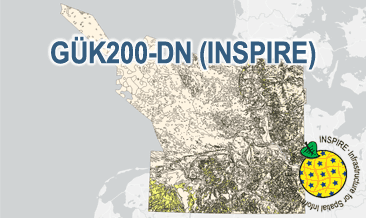
The General Geological Map of the Federal Republic of Germany 1:200,000 (GÜK200) provides detailed information on the stratigraphy, petrography and genesis of the geological units shown. In this revised GÜK200-DN, the onshore surface geology is shown in up to two overlays. The thin overlying soil is not shown. In the marine environment, only the petrography of the recent seabed is shown, which comprises the uppermost 20 cm of the seabed. In accordance with the original GÜK200 map sheets, the seabed is referred to stratigraphically as the recent seabed. According to the Data Specification on Geology (D2.8.II.4_v3.0) the geological map provides INSPIRE-compliant data. A base layer and two overlay layers are displayed correspondingly to the INSPIRE portrayal rules. The geologic units are represented graphically by stratigraphy (GE.GeologicUnit.BaseLayer.AgeOfRocks, GE.GeologicUnit.OverlayLayer1.AgeOfRocks, and GE.GeologicUnit.OverlayLayer2.AgeOfRocks) and lithology (GE.GeologicUnit.BaseLayer.Lithology, GE.GeologicUnit.OverlayLayer1.Lithology, and GE.GeologicUnit.OverlayLayer2.Lithology). The user obtains detailed information via the getFeatureInfo request on the lithology, stratigraphy (age) and genesis (event environment and event process).