 My GeoNetwork catalogue
GOME-2
Provided by
Type of resources
Available actions
Topics
Keywords
Contact for the resource
Update frequencies
-
The MPIC/DLR "climate" water vapor product, developed within ESA's "GOME Evolution" project, provides a consistent time series of monthly mean H2O columns from the satellite instruments GOME, SCIAMACHY, and GOME-2 (MetopA). Consistency amongst the different instruments (including cloud treatment) is substantially improved by (1) merging SCIAMACHY and GOME-2 observations to GOME pixel size, and (2) reducing the GOME-2 swath width to GOME/SCIAMACHY swath, thereby mimicking GOME-like observation conditions for all three sensors. WARNING: Version 1.0 is based on spectral analysis settings which have slightly changed during the GOME-2 timeseries, introducing a small but clear "jump" in the TCWV timeseries at the turn of the years 2012/2013. This version should not be used any more! Use version >2.2 instead! doi:10.1594/WDCC/GOME-EVL_water_vapor_clim_v2.2
-
The "climate" water vapor product developed within ESA's "GOME-Evolution" project provides a consistent time series of monthly mean global maps of total column water vapor derived from the satellite instruments GOME, SCIAMACHY, and GOME-2 (Metop-A). Consistency amongst the different instruments (including cloud treatment) is substantially improved by (1) merging SCIAMACHY and GOME-2 observations to GOME pixel size, and (2) reducing the GOME-2 swath width to GOME/SCIAMACHY swath, thereby mimicking GOME-like observation conditions for all three sensors. Use version >2.2 instead! doi:10.1594/WDCC/GOME-EVL_water_vapor_clim_v2.2
-
The MPIC/DLR "climate" water vapor product, developed within ESA's "GOME Evolution" project, provides a consistent time series of monthly mean H2O columns from the satellite instruments GOME, SCIAMACHY, and GOME-2 (MetopA). Consistency amongst the different instruments (including cloud treatment) is substantially improved by (1) merging SCIAMACHY and GOME-2 observations to GOME pixel size, and (2) reducing the GOME-2 swath width to GOME/SCIAMACHY swath, thereby mimicking GOME-like observation conditions for all three sensors. WARNING: Version 1.0 is based on spectral analysis settings which have slightly changed during the GOME-2 timeseries, introducing a small but clear "jump" in the TCWV timeseries at the turn of the years 2012/2013. This version should not be used any more! Use version >2.2 instead! doi:10.1594/WDCC/GOME-EVL_water_vapor_clim_v2.2
-
The "climate" water vapor product developed within ESA's "GOME-Evolution" project provides a consistent time series of monthly mean global maps of total column water vapor derived from the satellite instruments GOME, SCIAMACHY, and GOME-2 (Metop-A). Consistency amongst the different instruments (including cloud treatment) is substantially improved by (1) merging SCIAMACHY and GOME-2 observations to GOME pixel size, and (2) reducing the GOME-2 swath width to GOME/SCIAMACHY swath, thereby mimicking GOME-like observation conditions for all three sensors. Use version >2.2 instead! doi:10.1594/WDCC/GOME-EVL_water_vapor_clim_v2.2
-
The "climate" water vapor product developed within ESA's "GOME-Evolution" project provides a consistent time series of monthly mean global maps of total column water vapor derived from the satellite instruments GOME, SCIAMACHY, and GOME-2 (Metop-A). Consistency amongst the different instruments (including cloud treatment) is substantially improved by (1) merging SCIAMACHY and GOME-2 observations to GOME pixel size, and (2) reducing the GOME-2 swath width to GOME/SCIAMACHY swath, thereby mimicking GOME-like observation conditions for all three sensors. This is Version 2.2
-
The "climate" water vapor product developed within ESA's "GOME-Evolution" project provides a consistent time series of monthly mean global maps of total column water vapor derived from the satellite instruments GOME, SCIAMACHY, and GOME-2 (Metop-A). Consistency amongst the different instruments (including cloud treatment) is substantially improved by (1) merging SCIAMACHY and GOME-2 observations to GOME pixel size, and (2) reducing the GOME-2 swath width to GOME/SCIAMACHY swath, thereby mimicking GOME-like observation conditions for all three sensors. This is Version 2.2
-
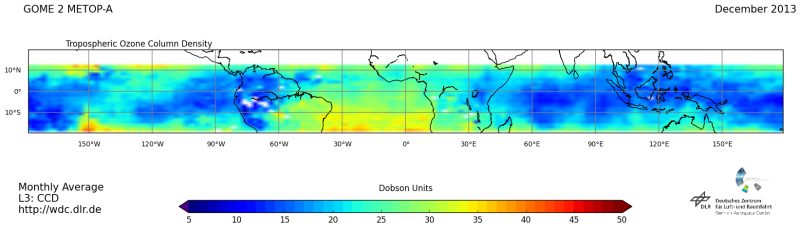
GOME (Global Ozone Monitoring Experiment) stands for a family of satellite instruments named after the first GOME (https://wdc.dlr.de/sensors/gome/) instrument on ERS-2 launched in April 1995. Currently two GOME-2 instruments are operative on Metop-A and B (https://wdc.dlr.de/sensors/gome2/). The tropical tropospheric ozone is retrieved with convective cloud differential method (Valks et al., 2014 http://www.atmos-meas-tech.net/7/2513/2014/amt-7-2513-2014.html). The tropospheric column is retrieved by subtracting the stratospheric ozone column from the total column. The stratospheric ozone column is estimated as the column above high reaching convective clouds.
-

The Global Ozone Monitoring Experiment-2 (GOME-2) instrument continues the long-term monitoring of atmospheric trace gas constituents started with GOME / ERS-2 and SCIAMACHY / Envisat. Currently, there are three GOME-2 instruments operating on board EUMETSAT's Meteorological Operational satellites MetOp-A, -B, and -C, launched in October 2006, September 2012, and November 2018, respectively. GOME-2 can measure a range of atmospheric trace constituents, with the emphasis on global ozone distributions. Furthermore, cloud properties and intensities of ultraviolet radiation are retrieved. These data are crucial for monitoring the atmospheric composition and the detection of pollutants. DLR generates operational GOME-2 / MetOp level 2 products in the framework of EUMETSAT's Satellite Application Facility on Atmospheric Chemistry Monitoring (AC-SAF). GOME-2 near-real-time products are available already two hours after sensing. The operational HCHO total column products are generated using the algorithm GDP (GOME Data Processor) version 4.x integrated into the UPAS (Universal Processor for UV / VIS Atmospheric Spectrometers) processor for generating level 2 trace gas and cloud products. For more details please refer to relevant peer-review papers listed on the GOME and GOME-2 documentation pages: https://atmos.eoc.dlr.de/app/docs/
-

Gridded Level 3 BrO total column densities derived from the Metop/GOME-2-instruments. In the troposphere BrO is a short-lived atmospheric constituent released from the sea (via algae or ice flowers). Also volcanic eruptions emit bromine compounds reacting to BrO. The main source for stratospheric BrO are halogenated hydrocarbos that are destroyed by high energy uv radiation. Here it is plays a key role in the ozone hole chemistry. The total BrO column is retrieved from GOME solar back-scattered measurements in the uv wavelength region between 332 and 359 nm [using the DOAS method]. The applied Airmassfactor is based on monthly climatologies. The Global Ozone Monitoring Experiment-2 (GOME-2) instrument continues the long-term monitoring of atmospheric trace gas constituents started with GOME / ERS-2 and SCIAMACHY / Envisat. Three instruments operate on board EUMETSAT's Meteorological Operational satellites MetOp-A, -B, and -C, launched in 2006, 2012, and 2018, respectively. GOME-2 measures a range of atmospheric trace constituents, with the emphasis on global ozone distribution. Furthermore, cloud properties and intensities of ultraviolet radiation are retrieved. These data are crucial for monitoring the atmospheric composition and the detection of pollutants. DLR generates operational GOME-2 / MetOp products in the framework of EUMETSAT's Satellite Application Facility on Atmospheric Composition Monitoring (AC-SAF).
-
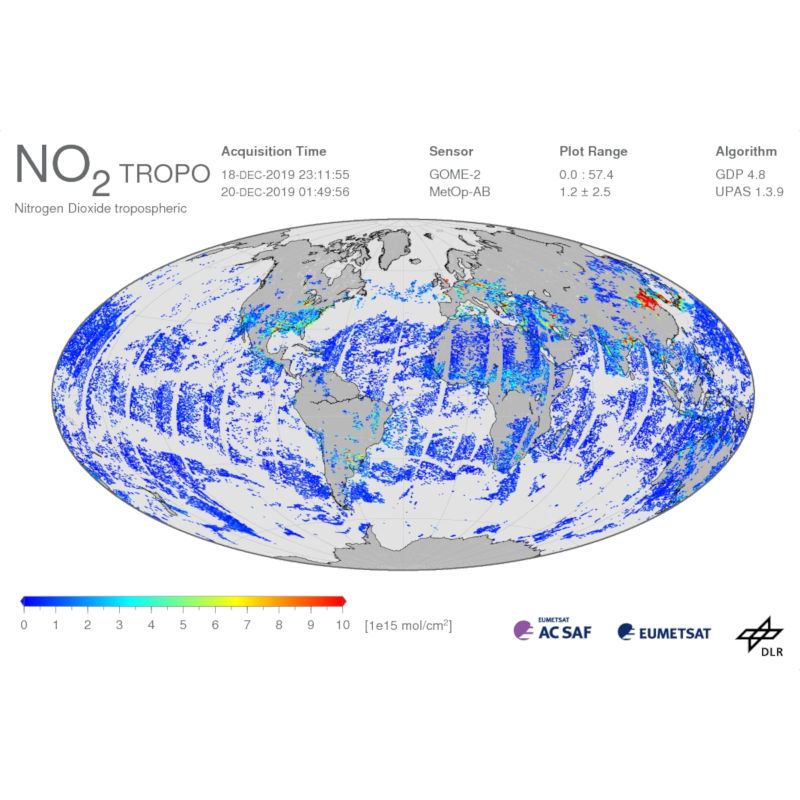
The Global Ozone Monitoring Experiment-2 (GOME-2) instrument continues the long-term monitoring of atmospheric trace gas constituents started with GOME / ERS-2 and SCIAMACHY / Envisat. Currently, there are three GOME-2 instruments operating on board EUMETSAT's Meteorological Operational satellites MetOp-A, -B, and -C, launched in October 2006, September 2012, and November 2018, respectively. GOME-2 can measure a range of atmospheric trace constituents, with the emphasis on global ozone distributions. Furthermore, cloud properties and intensities of ultraviolet radiation are retrieved. These data are crucial for monitoring the atmospheric composition and the detection of pollutants. DLR generates operational GOME-2 / MetOp level 2 products in the framework of EUMETSAT's Satellite Application Facility on Atmospheric Chemistry Monitoring (AC-SAF). GOME-2 near-real-time products are available already two hours after sensing. The operational NO2 total column products are generated using the algorithm GDP (GOME Data Processor) version 4.x integrated into the UPAS (Universal Processor for UV / VIS Atmospheric Spectrometers) processor for generating level 2 trace gas and cloud products. The operational NO2 tropospheric column products are generated using the algorithm GDP (GOME Data Processor) version 4.x for NO2 [Valks et al. (2011)] integrated into the UPAS (Universal Processor for UV / VIS Atmospheric Spectrometers) processor for generating level 2 trace gas and cloud products. The total NO2 column is retrieved from GOME solar back-scattered measurements in the visible wavelength region using the DOAS method. An additional algorithm is applied to derive the tropospheric NO2 column: after subtracting the estimated stratospheric component from the total column, the tropospheric NO2 column is determined using an air mass factor based on monthly climatological NO2 profiles from the MOZART-2 model. For more details please refer to relevant peer-review papers listed on the GOME and GOME-2 documentation pages: https://atmos.eoc.dlr.de/app/docs/