 My GeoNetwork catalogue
Remote Sensing
Provided by
Type of resources
Update frequencies
Service types
-

The diverse geology of Germany and the resulting use are the causes of a wide variety of ground motions, such as soil compaction, landslides, groundwater extraction, natural gas extraction, (abandoned) mining and cavern storage operations. The products of the Ground Motion Service Germany (BBD) are based on SAR data from the Copernicus Sentinel-1 mission and Persistent Scatterer Interferometry (PSI) processing. The BBD portal contains PSI data from the entire Federal Republic of Germany (approx. 360,000 km²). PSI technology enables precise measurements of ground motions in the mm range. The decomposed virtual PS are visualized according to the mean velocity along vertical direction according to the following convention in the BBD portal: - the green color corresponds to the virtual PS, whose average speed is very low, between -2.0 and +2.0 mm/year, i.e. in the sensitivity range of the PSI technology; - those virtual PS with a negative movement rate are visualized in the colors from yellow to red, i.e. downward movement; - the colors from turquoise to blue visualize those virtual PS with a positive movement rate, i.e. upward movement. The precision of the PSI data presented is on the order of typically +- 2 mm/year for the average velocity.
-
The diverse geology of Germany and the resulting use are the causes of a wide variety of ground motions, such as soil compaction, landslides, groundwater extraction, natural gas extraction, (abandoned) mining and cavern storage operations. The products of the Ground Motion Service Germany (BBD) are based on SAR data from the Copernicus Sentinel-1 mission and Persistent Scatterer Interferometry (PSI) processing. The BBD portal contains PSI data from the entire Federal Republic of Germany (approx. 360,000 km²). PSI technology enables precise measurements of ground motions in the mm range. The measuring points (Persistent Scatterer, PS) correspond to objects already present on the ground, such as buildings, infrastructure or natural objects such as rocks. Each PS is characterized by a velocity value averaged over several years (expressed in mm/year) and a time series of displacements. For each PS, the time series of displacements from the first Sentinel-1 acquisition to the last evaluated Sentinel-1 acquisition can be viewed. The PS are visualized according to the mean velocity along the line of sight (LOS) of the Sentinel-1 satellites according to the following convention in the BBD portal: - the green color corresponds to the PS, whose average speed is very low, between -2.0 and +2.0 mm/year, i.e. in the sensitivity range of the PSI technology; - those PS with a negative movement rate are visualized in the colors from yellow to red, i.e. movements away from the satellite; - the colors from turquoise to blue visualize those PS with a positive movement rate, i.e. PS that are approaching the satellite. The precision of the PSI data presented is on the order of typically +- 2 mm/year for the average velocity in LOS.
-
The diverse geology of Germany and the resulting use are the causes of a wide variety of ground motions, such as soil compaction, landslides, groundwater extraction, natural gas extraction, (abandoned) mining and cavern storage operations. The products of the Ground Motion Service Germany (BBD) are based on SAR data from the Copernicus Sentinel-1 mission and Persistent Scatterer Interferometry (PSI) processing. The BBD portal contains PSI data from the entire Federal Republic of Germany (approx. 360,000 km²). PSI technology enables precise measurements of ground motions in the mm range. The decomposed virtual PS are visualized according to the mean velocity along East-West direction according to the following convention in the BBD portal: - the green color corresponds to the virtual PS, whose average speed is very low, between -2.0 and +2.0 mm/year, i.e. in the sensitivity range of the PSI technology; - those virtual PS with a negative movement rate are visualized in the colors from yellow to red, i.e. movements to the West; - the colors from turquoise to blue visualize those virtual PS with a positive movement rate, i.e. movements to the East. The precision of the PSI data presented is on the order of typically +- 2 mm/year for the average velocity.
-
The diverse geology of Germany and the resulting use are the causes of a wide variety of ground motions, such as soil compaction, landslides, groundwater extraction, natural gas extraction, (abandoned) mining and cavern storage operations. The products of the Ground Motion Service Germany (BBD) are based on SAR data from the Copernicus Sentinel-1 mission and Persistent Scatterer Interferometry (PSI) processing. The BBD portal contains PSI data from the entire Federal Republic of Germany (approx. 360,000 km²). PSI technology enables precise measurements of ground motions in the mm range. The measuring points (Persistent Scatterer, PS) correspond to objects already present on the ground, such as buildings, infrastructure or natural objects such as rocks. Each PS is characterized by a velocity value averaged over several years (expressed in mm/year) and a time series of displacements. For each PS, the time series of displacements from the first Sentinel-1 acquisition to the last evaluated Sentinel-1 acquisition can be viewed. The PS are visualized according to the mean velocity along the line of sight (LOS) of the Sentinel-1 satellites according to the following convention in the BBD portal: - the green color corresponds to the PS, whose average speed is very low, between -2.0 and +2.0 mm/year, i.e. in the sensitivity range of the PSI technology; - those PS with a negative movement rate are visualized in the colors from yellow to red, i.e. movements away from the satellite; - the colors from turquoise to blue visualize those PS with a positive movement rate, i.e. PS that are approaching the satellite. The precision of the PSI data presented is on the order of typically +- 2 mm/year for the average velocity in LOS.
-
The diverse geology of Germany and the resulting use are the causes of a wide variety of ground motions, such as soil compaction, landslides, groundwater extraction, natural gas extraction, (abandoned) mining and cavern storage operations. The products of the Ground Motion Service Germany (BBD) are based on SAR data from the Copernicus Sentinel-1 mission and Persistent Scatterer Interferometry (PSI) processing. The BBD portal contains PSI data from the entire Federal Republic of Germany (approx. 360,000 km²). PSI technology enables precise measurements of ground motions in the mm range. The decomposed virtual PS are visualized according to the mean velocity along East-West direction according to the following convention in the BBD portal: - the green color corresponds to the virtual PS, whose average speed is very low, between -2.0 and +2.0 mm/year, i.e. in the sensitivity range of the PSI technology; - those virtual PS with a negative movement rate are visualized in the colors from yellow to red, i.e. movements to the West; - the colors from turquoise to blue visualize those virtual PS with a positive movement rate, i.e. movements to the East. The precision of the PSI data presented is on the order of typically +- 2 mm/year for the average velocity.
-
The diverse geology of Germany and the resulting use are the causes of a wide variety of ground motions, such as soil compaction, landslides, groundwater extraction, natural gas extraction, (abandoned) mining and cavern storage operations. The products of the Ground Motion Service Germany (BBD) are based on SAR data from the Copernicus Sentinel-1 mission and Persistent Scatterer Interferometry (PSI) processing. The BBD portal contains PSI data from the entire Federal Republic of Germany (approx. 360,000 km²). PSI technology enables precise measurements of ground motions in the mm range. The decomposed virtual PS are visualized according to the mean velocity along vertical direction according to the following convention in the BBD portal: - the green color corresponds to the virtual PS, whose average speed is very low, between -2.0 and +2.0 mm/year, i.e. in the sensitivity range of the PSI technology; - those virtual PS with a negative movement rate are visualized in the colors from yellow to red, i.e. downward movement; - the colors from turquoise to blue visualize those virtual PS with a positive movement rate, i.e. upward movement. The precision of the PSI data presented is on the order of typically +- 2 mm/year for the average velocity.
-
The diverse geology of Germany and the resulting use are the causes of a wide variety of ground motions, such as soil compaction, landslides, groundwater extraction, natural gas extraction, (abandoned) mining and cavern storage operations. The products of the Ground Motion Service Germany (BBD) are based on SAR data from the Copernicus Sentinel-1 mission and Persistent Scatterer Interferometry (PSI) processing. The BBD portal contains PSI data from the entire Federal Republic of Germany (approx. 360,000 km²). PSI technology enables precise measurements of ground motions in the mm range. The measuring points (Persistent Scatterer, PS) correspond to objects already present on the ground, such as buildings, infrastructure or natural objects such as rocks. Each PS is characterized by a velocity value averaged over several years (expressed in mm/year) and a time series of displacements. For each PS, the time series of displacements from the first Sentinel-1 acquisition to the last evaluated Sentinel-1 acquisition can be viewed. The PS are visualized according to the mean velocity along the line of sight (LOS) of the Sentinel-1 satellites according to the following convention in the BBD portal: - the green color corresponds to the PS, whose average speed is very low, between -2.0 and +2.0 mm/year, i.e. in the sensitivity range of the PSI technology; - those PS with a negative movement rate are visualized in the colors from yellow to red, i.e. movements away from the satellite; - the colors from turquoise to blue visualize those PS with a positive movement rate, i.e. PS that are approaching the satellite. The precision of the PSI data presented is on the order of typically +- 2 mm/year for the average velocity in LOS.
-
The diverse geology of Germany and the resulting use are the causes of a wide variety of ground motions, such as soil compaction, landslides, groundwater extraction, natural gas extraction, (abandoned) mining and cavern storage operations. The products of the Ground Motion Service Germany (BBD) are based on SAR data from the Copernicus Sentinel-1 mission and Persistent Scatterer Interferometry (PSI) processing. The BBD portal contains PSI data from the entire Federal Republic of Germany (approx. 360,000 km²). PSI technology enables precise measurements of ground motions in the mm range. The measuring points (Persistent Scatterer, PS) correspond to objects already present on the ground, such as buildings, infrastructure or natural objects such as rocks. Each PS is characterized by a velocity value averaged over several years (expressed in mm/year) and a time series of displacements. For each PS, the time series of displacements from the first Sentinel-1 acquisition to the last evaluated Sentinel-1 acquisition can be viewed. The PS are visualized according to the mean velocity along the line of sight (LOS) of the Sentinel-1 satellites according to the following convention in the BBD portal: - the green color corresponds to the PS, whose average speed is very low, between -2.0 and +2.0 mm/year, i.e. in the sensitivity range of the PSI technology; - those PS with a negative movement rate are visualized in the colors from yellow to red, i.e. movements away from the satellite; - the colors from turquoise to blue visualize those PS with a positive movement rate, i.e. PS that are approaching the satellite. The precision of the PSI data presented is on the order of typically +- 2 mm/year for the average velocity in LOS.
-
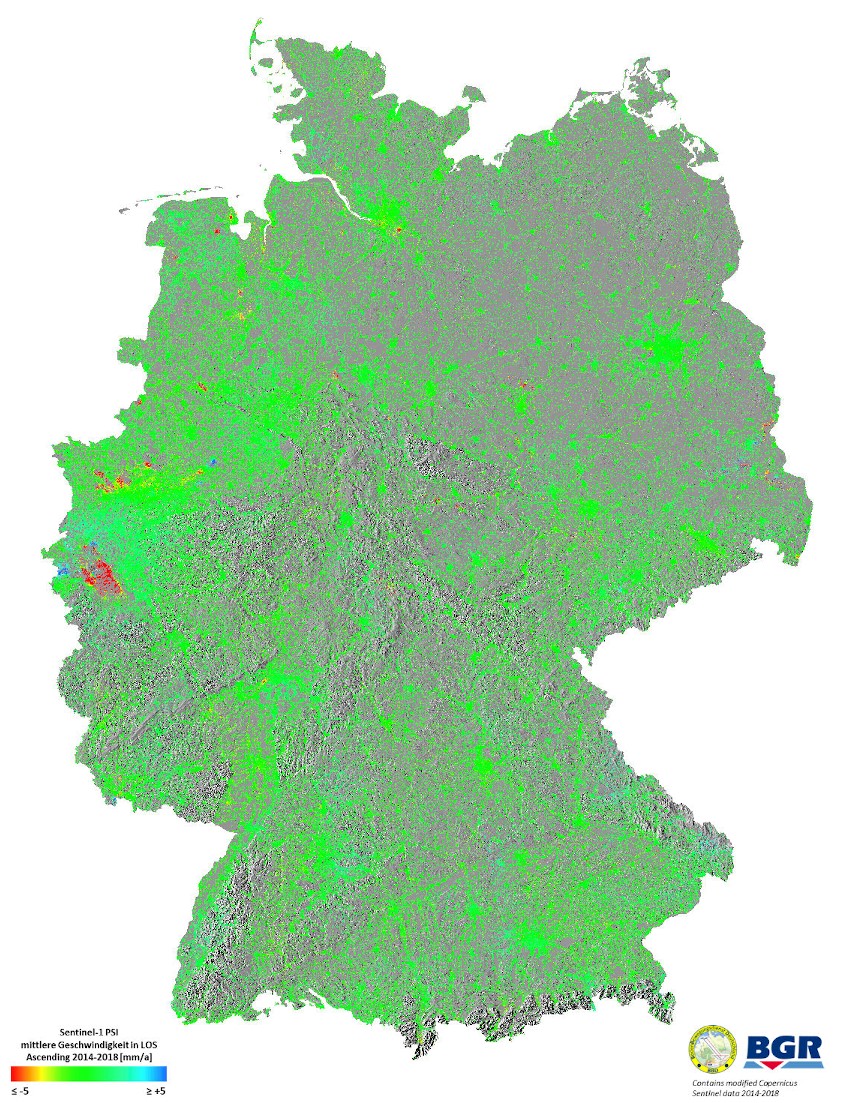
The data set provides information on the surface deformation of Germany. The surface deformation is color coded as the mean velocity over the time span indicated in the title. The data set was generated using a Persistent Scatterer Interferometry analysis based on Copernicus Sentinel-1 SAR data. The data set contains modified Copernicus Sentinel-1 data 2014-2019
-
Spatially and temporally high-resolution data was acquired with the aid of multispectral sensors mounted on UAV and a gyrocopter platform for the purpose of classification. The work was part of the research and development project „Modern sensors and airborne remote sensing for the mapping of vegetation and hydromorphology along Federal waterways in Germany“ (mDRONES4rivers) in cooperation of the German Federal Institute of Hydrology (BfG), Geocoptix GmbH, Hochschule Koblenz und JB Hyperspectral Devices. Within the project period (2019-2022) data was collected at different sites situated in Germany along the Rivers Rhine and Oder. All published data produced within the project can be found by searching for the keyword ‘mDRONES4rivers‘. In this dataset, the following UAS data and metadata of the project site ‘Nonnenwerth’ (center coordinates [WGS84]: 50.637541°N, 7.208834°E; area: 8 ha) at the Rhine River in Germany is available for download: • Multispectral orthophotos (GeoTiff; 6 bands: B, G, R, Red-Edge, NIR, Flag; camera: Micasense; resolution: 25 cm; abbreviation: MS_RAW) • RGB-orthophotos (GeoTiff; 3 bands: R, G, B; camera: Phantom; resolution: 25 cm; abbreviation: PH_ORTHO) • Digital Surface Models (GeoTiff; 1 band; camera: Phantom; resolution: ca. 5 cm; abbreviation: PH_DEM) • associated Technical Reports (PDF; technical metadata concerning data acquisition, and processing using Agisoft Metashape, 1x for multispectral orthophotos, 1x for RGB-orthophotos + digital surface model) The above-mentioned files are provided for download as dataset stored in one directory per season depending on the date of data acquisition (e.g. mDRONES4rivers_NW_UAV_2019_01_Winter.zip = projectname_projectsite_platform_year_no.season_name.season). To provide an overview of all files and general background information plus data preview the following files are stored in the info.zip folder: • Overview table and metadata of the above-mentioned data (xlsx) • Summary (PDF, Detailed description of sensors and data acquisition procedure, 1x for multispectral orthophotos, 1x for RGB-orthophotos + digital surface models) Note: the data was processed with focus on spectral information and not for geodetic purposes. Georeferencing accuracy has not been checked in detail.