 My GeoNetwork catalogue
West Africa
Provided by
Type of resources
Topics
Keywords
Contact for the resource
-
This experiment (2006-2100) uses the data from the WRF60_mpiesm_rcp45 experiment as forcing data for downscaling to 12km resolution by the regional model WRFV3.5.1 for the region of West Africa. 'rcp45' is an experiment of the CMIP5 - Coupled Model Intercomparison Project Phase 5 (https://pcmdi.llnl.gov/mips/cmip5). 4.1 rcp45 (4.1 RCP4.5) - future projection (2006-2300) forced by RCP4.5. Experiment design:https://cera-www.dkrz.de/WDCC/ui/Entry.jsp?acronym=Taylor_CMIP5_design.pdf . This experiment is divided into several time slices of 11 years. The first year of each time slice is used as a spin-up phase and should not be used in the analysis. All experiments with MPIESM forcing refer to a Gregorian calendar. The 12 km resolution of this experiment is the second step of the two step downscaling WRF experiment.
-
While climate information from General Circulation Models (GCMs) are usually too coarse for climate impact modelers or decision makers from various disciplines (e.g., hydrology, agriculture), Regional Climate Models (RCMs) and Regional Earth System Models (RESMs) provide feasible solutions for downscaling GCM output to finer spatiotemporal scales. However, it is well known that the model performance depends largely on the choice of the physical parameterization schemes, but optimal configurations may vary from region to region. Besides land-surface processes, the most crucial processes to be parameterized in ESMs include radiation (RA), cumulus convection (CU), cloud microphysics (MP), and planetary boundary layer (PBL), partly with complex interactions. Before conducting long-term climate simulations, it is therefore indispensable to identify a suitable combination of physics parameterization schemes for these processes. Using the European Centre for Medium-Range Weather Forecasts (ECMWF) reanalysis product ERA-Interim as lateral boundary conditions, we derived an ensemble of 16 physics parameterization runs for a larger domain in Northern sub-Saharan Africa (NSSA), northwards of the equator, using two different CU-, MP-, PBL-, and RA schemes, respectively, using the Weather Research and Forecasting (WRF) model (Version v3.9) for the period 2006-2010 in a resolution of 0.1 degree horizontal resolution. Conclusions about suitable physical parameterization schemes may vary within the study area. We therefore want to stimulate the development of own performance evaluation studies for climate simulations or subsequent impact studies over specific (sub-)regions in NSSA. For this reason, selected climate surface variables of the physics ensemble (i.e. the 16 experiments from 2006-2010) are provided. For more information about the setup of the experiments, please see: Laux et al., 2021: A high-resolution regional climate model physics ensemble for Northern sub-Saharan Africa. Frontiers in Earth Science (under revision).
-
This experiment (2006-2100) uses the data from the WRF60_mpiesm_rcp45 experiment as forcing data for downscaling to 12km resolution by the regional model WRFV3.5.1 for the region of West Africa. 'rcp45' is an experiment of the CMIP5 - Coupled Model Intercomparison Project Phase 5 (https://pcmdi.llnl.gov/mips/cmip5). 4.1 rcp45 (4.1 RCP4.5) - future projection (2006-2300) forced by RCP4.5. Experiment design:https://cera-www.dkrz.de/WDCC/ui/Entry.jsp?acronym=Taylor_CMIP5_design.pdf . This experiment is divided into several time slices of 11 years. The first year of each time slice is used as a spin-up phase and should not be used in the analysis. All experiments with MPIESM forcing refer to a Gregorian calendar. The 12 km resolution of this experiment is the second step of the two step downscaling WRF experiment.
-
While climate information from General Circulation Models (GCMs) are usually too coarse for climate impact modelers or decision makers from various disciplines (e.g., hydrology, agriculture), Regional Climate Models (RCMs) and Regional Earth System Models (RESMs) provide feasible solutions for downscaling GCM output to finer spatiotemporal scales. However, it is well known that the model performance depends largely on the choice of the physical parameterization schemes, but optimal configurations may vary from region to region. Besides land-surface processes, the most crucial processes to be parameterized in ESMs include radiation (RA), cumulus convection (CU), cloud microphysics (MP), and planetary boundary layer (PBL), partly with complex interactions. Before conducting long-term climate simulations, it is therefore indispensable to identify a suitable combination of physics parameterization schemes for these processes. Using the European Centre for Medium-Range Weather Forecasts (ECMWF) reanalysis product ERA-Interim as lateral boundary conditions, we derived an ensemble of 16 physics parameterization runs for a larger domain in Northern sub-Saharan Africa (NSSA), northwards of the equator, using two different CU-, MP-, PBL-, and RA schemes, respectively, using the Weather Research and Forecasting (WRF) model (Version v3.9) for the period 2006-2010 in a resolution of 0.1 degree horizontal resolution. Conclusions about suitable physical parameterization schemes may vary within the study area. We therefore want to stimulate the development of own performance evaluation studies for climate simulations or subsequent impact studies over specific (sub-)regions in NSSA. For this reason, selected climate surface variables of the physics ensemble (i.e. the 16 experiments from 2006-2010) are provided. For more information about the setup of the experiments, please see: Laux et al., 2021: A high-resolution regional climate model physics ensemble for Northern sub-Saharan Africa. Frontiers in Earth Science (under revision).
-
While climate information from General Circulation Models (GCMs) are usually too coarse for climate impact modelers or decision makers from various disciplines (e.g., hydrology, agriculture), Regional Climate Models (RCMs) and Regional Earth System Models (RESMs) provide feasible solutions for downscaling GCM output to finer spatiotemporal scales. However, it is well known that the model performance depends largely on the choice of the physical parameterization schemes, but optimal configurations may vary from region to region. Besides land-surface processes, the most crucial processes to be parameterized in ESMs include radiation (RA), cumulus convection (CU), cloud microphysics (MP), and planetary boundary layer (PBL), partly with complex interactions. Before conducting long-term climate simulations, it is therefore indispensable to identify a suitable combination of physics parameterization schemes for these processes. Using the European Centre for Medium-Range Weather Forecasts (ECMWF) reanalysis product ERA-Interim as lateral boundary conditions, we derived an ensemble of 16 physics parameterization runs for a larger domain in Northern sub-Saharan Africa (NSSA), northwards of the equator, using two different CU-, MP-, PBL-, and RA schemes, respectively, using the Weather Research and Forecasting (WRF) model (Version v3.9) for the period 2006-2010 in a resolution of 0.1 degree horizontal resolution. Conclusions about suitable physical parameterization schemes may vary within the study area. We therefore want to stimulate the development of own performance evaluation studies for climate simulations or subsequent impact studies over specific (sub-)regions in NSSA. For this reason, selected climate surface variables of the physics ensemble (i.e. the 16 experiments from 2006-2010) are provided. For more information about the setup of the experiments, please see: Laux et al., 2021: A high-resolution regional climate model physics ensemble for Northern sub-Saharan Africa. Frontiers in Earth Science (under revision).
-
While climate information from General Circulation Models (GCMs) are usually too coarse for climate impact modelers or decision makers from various disciplines (e.g., hydrology, agriculture), Regional Climate Models (RCMs) and Regional Earth System Models (RESMs) provide feasible solutions for downscaling GCM output to finer spatiotemporal scales. However, it is well known that the model performance depends largely on the choice of the physical parameterization schemes, but optimal configurations may vary from region to region. Besides land-surface processes, the most crucial processes to be parameterized in ESMs include radiation (RA), cumulus convection (CU), cloud microphysics (MP), and planetary boundary layer (PBL), partly with complex interactions. Before conducting long-term climate simulations, it is therefore indispensable to identify a suitable combination of physics parameterization schemes for these processes. Using the European Centre for Medium-Range Weather Forecasts (ECMWF) reanalysis product ERA-Interim as lateral boundary conditions, we derived an ensemble of 16 physics parameterization runs for a larger domain in Northern sub-Saharan Africa (NSSA), northwards of the equator, using two different CU-, MP-, PBL-, and RA schemes, respectively, using the Weather Research and Forecasting (WRF) model (Version v3.9) for the period 2006-2010 in a resolution of 0.1 degree horizontal resolution. Conclusions about suitable physical parameterization schemes may vary within the study area. We therefore want to stimulate the development of own performance evaluation studies for climate simulations or subsequent impact studies over specific (sub-)regions in NSSA. For this reason, selected climate surface variables of the physics ensemble (i.e. the 16 experiments from 2006-2010) are provided. For more information about the setup of the experiments, please see: Laux et al., 2021: A high-resolution regional climate model physics ensemble for Northern sub-Saharan Africa. Frontiers in Earth Science (under revision).
-
The experiment aims to investigate how the representation of convection influences the West African Monsoon during the mid-Holocene. Atmospheric and SST input data originate from the MPI-ESM Holocene simulations reflecting Holocene condition. External Parameters (surface condition) reflect present-day conditions similar to the experimental setup of PMIP1: The Sahara remains a desert. We use the ICON (ICOsahedral Nonhydrostatic) model framework version 2.5.0 (see Zängl et al. (2014) for more details). The provided data covers one simulation from June to October (JJASO) for the year 7023 before present (BP) with the year 2000 as the reference year. The time axes of the NetCDF files reflect the model year which is based on the time axes of the MPI-ESM slo0021a Holocene simulations. The artificial model year 1001 in slo0021a refers to the year 8000 BP. Therefore, the model year 1977 refers to the year 7023 BP. The experiment compares a 5km horizontal resolution, cloud-resolving simulation with a 40km-horizontal resolution, parameterized convection simulation. The 40km-domain (DOM01) covers a range from 70.5°W - 99.5°E; 49°S - 59°N The 5km-domain (DOM04) covers a range from 37°W - 53°E; 0°N - 40°N The dataset provides daily mean values on the triangular ICON grid. The datasets provide atmospheric (3D), surface (2D) and precipitation (2D) data an the following variables: rain_con_rate, rain_gsp_rate, clct, geopot, temp, rh, qv, u, v, w, w_so, runoff_g, runoff_s, lhfl_s, shfl_s, soiltyp
-
The experiment aims to investigate how the representation of convection influences the West African Monsoon during the mid-Holocene. Atmospheric and SST input data originate from the MPI-ESM Holocene simulations reflecting Holocene condition. External Parameters (surface condition) were adjusted to reflect mid-Holocene vegetation conditions. We prescribe an idealized, denser vegetation cover based on the simulated desert fraction (1-vegetation fraction) of the transient mid-Holocene MPI-ESM simulations (Dallmeyer et al., 2020). We use the ICON (ICOsahedral Nonhydrostatic) model framework version 2.5.0 (see Zängl et al. (2014) for more details). The provided data covers one simulation from June to October (JJASO) for the year 7024 before present (BP) with the year 2000 as the reference year. The time axes of the NetCDF files reflect the model year which is based on the time axes of the MPI-ESM slo0021a Holocene simulations. The artificial model year 1001 in slo0021a refers to the year 8000 BP. Therefore, the model year 1978 refers to the year 7024 BP. The experiment compares a 5km horizontal resolution, deep convection resolving simulation with a 40km-horizontal resolution, parameterized convection simulation. The 40km-domain (DOM01) covers a range from 70.5°W - 99.5°E; 49°S - 59°N The 5km-domain (DOM04) covers a range from 37°W - 53°E; 0°N - 40°N The dataset provides daily mean values on the triangular ICON grid. The datasets provide atmospheric (_atm_ 3D), surface (_sfc_ 2D) and precipitation ( _prec_ 2D) and forcing (extpar_) data and the following variables: w_so, lhfl_s, shfl_s, runoff_s, runoff_g, rain_con_rate, rain_gsp_rate, geopot, temp, rh, qv, u, v, w, clc Precipitation and forcing data are combined into 2 data files for DOM01 and DOM04. Surface data are combined into 2 data files for DOM01. The dataset with the suffix "_constSM_sep_" contains the data for the constant soil moisture simulations. In these simulations we prescribe the same constant soil moisture field, representing 1st September-soil moisture conditions, both for the 40km-P (DOM01) and the 5km-E (DOM04) simulations. The DS ("Dry Sahara") simulations refer to the simulations where we prescribe present-day land surface cover - the Sahara remains a desert. The GS ("Green Sahara") simulations represent idealized mid-Holocene conditions where we prescribe a higher vegetation cover that also extend further north. The Sahara reflects more savannah-like vegetation.
-
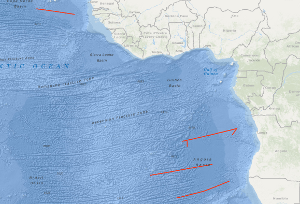
The BGR 1991 cruise with M.V. BIN HAI 511 was designed to study the variability of the oceanic crustal structure along flow-line profiles perpendicular to the ridge axis over Early Tertiary through Cretaceous old oceanic crust of the eastern Atlantic Ocean. Seismic data with a coverage of 3,000 % were acquired along four flow-line profiles with a total length of 4,194 km, and in addition 270 km of MCS data were collected during the period from 2nd October to the 3rd November 1991. The most intriguing new observation from the seismic flow-line profiles is the discovery of two huge oceanic crustal structures characterized by an internally divergent to planar pattern of reflectors having ubiquitous seaward dip. These remarkable structures were found within an about 1,300 km long oceanic crust segment of the eastern South Atlantic located between the Bode Verde Fracture zone in the north and the Rio Grande Fracture Zone in the south. These structures resemble the prominent wedges of seaward dipping reflectors on the widespread volcanic rifted continental margins described in the literature. They are interpreted to represent voluminous build-ups of layered extrusive rocks formed during three excessive episodes of volcanism that accompanied the Cretaceous opening of the South Atlantic. These episodes of excessive volcanism/magmatism are: An episode immediate prior to, and during the first stage of seafloor spreading in the South Atlantic, i.e. during about Hauterivian through about early Aptian; an episode of inferred subaerial and/or shallow marine volcanism along the central South Atlantic spreading ridge during the Albian; and an episode of inferred subaerial and/or shallow marine volcanism along the South Atlantic spreading ridge during latest Cenomanian/earliest Turonian through early Campanian.
-
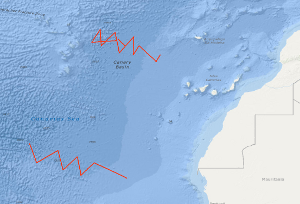
In continuation of a fracture zone survey of BGR in 1985, there was a multichannel seismic survey of the Hayes Fracture Zone between 20°W and 27°W in the time from October 26th to November 11th, 1988. In spite of bad weather conditions, it was possible to collect a total of 1.760 km seismic and gravity data on 11 lines. From a first interpretation of the seismic monitor records on board it appears that the frequency of intra-crustal reflections in the records from the area west of 20°W is much less than on the records of the survey of the previous cruise in 1985. During a second leg in the time period from 14th November to 21th November 1988 an additional seismic survey of the Kane Fracture Zone took place with 7 supplementary profiles.