 My GeoNetwork catalogue
Geophysik
Provided by
Type of resources
Available actions
Topics
Keywords
Contact for the resource
Update frequencies
Service types
-
Within the framework of DOVE and its topical questions, the project Chatseis combines two seismic methods to increase resolution and reliability of the seismic data; i.e. reflection imaging and full-waveform inversion. To acquire the data for the methodical development and to answer open topical questions, the German Federal Institute for Geosciences and Resources conducted a seismic survey together with the LIAG Institute for Applied Geophysics (LIAG), and the BOKU University Vienna at DOVE site 5068_5 (Bad Aussee). The project team registered seismic P-wave and S-wave data on four profiles (in total approx. 3.5 km, 17.8 GB for P-wave and approx. 2.8 km, 12.7 GB for S-wave).
-
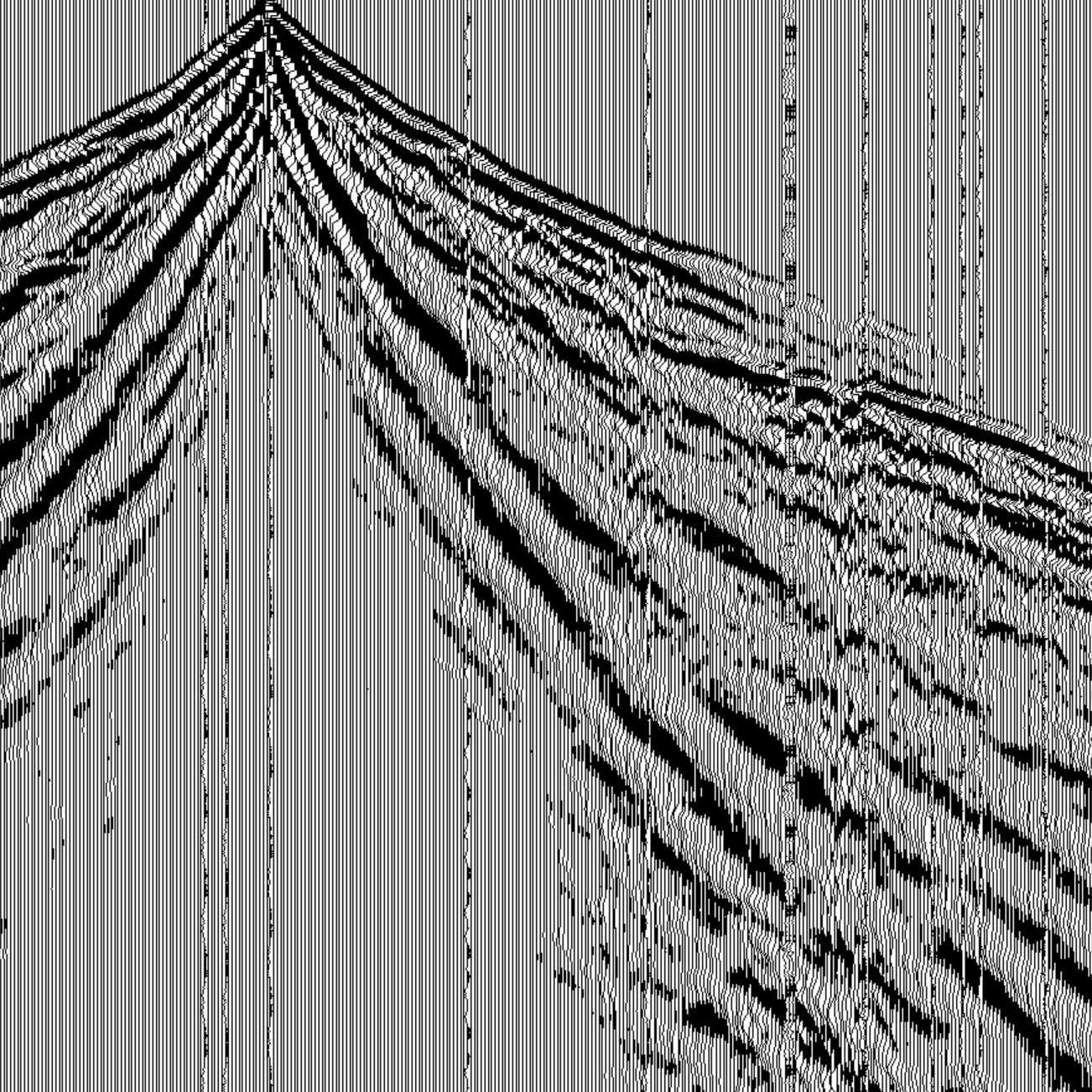
Within the framework of DOVE, the project Chatseis combines two seismic methods to increase resolution and reliability of the seismic data; i.e. reflection imaging and full-waveform inversion. To acquire the optimal data for the tasks in the project Chatseis, the German Federal Institute for Geosciences and Resources conducted two seismic surveys together with the Leibniz Institute for Applied Geophysics and the Bayerisches Landesamt für Umwelt. At the DOVE-site 5068_3 (Schäftlarn), the project team registered seismic P-wave data with explosive and vibration sources and different geophones as well as S-wave data with a small-scale vibratory source and a landstreamer system on three profiles (in total ca 3.8 km, 100 GB for P-wave and ca 2.6 km, 16 GB for S-wave).
-
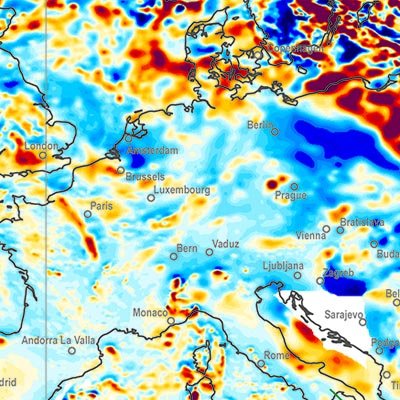
A global Earth Magnetic Anomaly Grid (EMAG2) was compiled from satellite, ship and airborne magnetic measurements. (Maus et al., 2009) Over the continents and the Arctic we made use of exisiting magnetic anomaly grids, whereas original ship and airborne trackline data were processed over the rest of the oceans, wherever available. CHAMP satellite magnetic measurements provided the magnetic field at wavelengths above 330 km. The EMAG2 grid is available at http://geomag.org and http://ngdc.noaa.gov. Directional gridding Due to the sparsity of magnetic field measurements in the southern oceans, it is necessary to interpolate the magnetic field between tracklines. Our interpolation algorithm takes the direction of the magnetic lineations into account. Tje lineations are parallel to the isochrons, which are perpendicular to the gradient of the age of teh oceanic crust. We use the age grid of Müller et al. (2008). The magnetic field ad a given grid point is computet by Least Squares Collocation from the surrounding measurements. If the point is on land, we use an isotropic correlation function with Rc = 14 km correlation length. Over the oceans we use Rc = 56 km parallel to the isochrons and Rc = 14 km in the spreading direction. Measurements seperated from the grid point by an age discontinuity or a topographic feature are excluded from the collation.
-
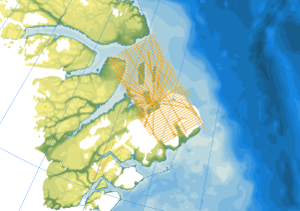
As part of the expedition CASE 20, geological fieldwork and an aeromagnetic survey were conducted in order to study the architecture and structure of the present continental margin of Northeast Greenland. The helicopter-borne magnetic survey in July and August 2018 covered the coastal areas between Independence Fiord and Kronprins Christian Land. During a 2-weeks period nearly 6500 km of aeromagnetic line data were collected covering an area of 17000 km². The distance between the individual lines was 4 km and control profiles were flown every 20-30 km. The aeromagnetic data were recorded by a magnetometer, which was towed approx. 30 m beneath the helicopter.
-
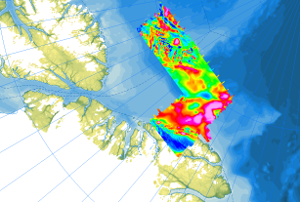
As part of the PMAP-CASE (Polar Margin Aeromagnetic Program - Circum-Arctic Structural Events) expeditions, two surveys were conducted in consecutive seasons in 1997 and 1998. Cooperating partners were the Department of National Defence (DND), GSC Ottawa and the Institute for Aerospace Research Ottawa (IAR-NRC). The surveys covered the areas of the northern continental margin of Greenland including the northern Nansen Land and western Johannes V. Jensen Land, as well as parts of the Lincoln Sea. The objective of the campaigns was to investigate the structures of the upper crust of the Morris Jesup Plateau and the correlation of magnetic anomalies with known structures and geologic units on land (Franklinian Basin, Kap Washington volcanics, and volcanic dyke swarms). Airborne magnetic surveys (Convair 580) were conducted with a 3 km flight line spacing, and control lines were flown every 30 km. Data were recorded at a constant flight altitude of 300 m above ground. Approximately 30000 km of line data were collected during the two expeditions, covering an area of 73000 km².
-
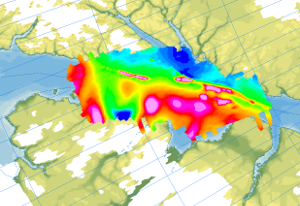
During the German-Canadian Nares Strait Expedition in 2001, an aeromagnetic survey was carried out across the northern part of the Nares Strait including the Hall Basin, Judge Daly Promontory and in Robeson Channel in cooperation with the Canadian GSC. The aim of the research was to detect and localize the Wegener Fault, a transform fault between Ellesmere Island and NW Greenland, which is closely linked to the opening of the North Atlantic and the Arctic Ocean. The helicopter-borne magnetic survey NARES I (Robeson Channel) was carried out with a flight line spacing of 2 km, and control profiles were flown every 10 km. During the expedition, 5470 km of line data were collected. The aeromagnetic data were recorded by a magnetometer, which was towed approx. 25 m beneath the helicopter and recorded at a constant altitude of 305 m (1000 ft) above ground.
-
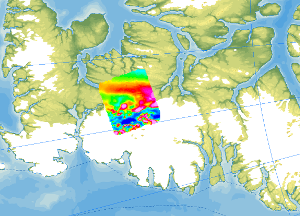
As part of the CASE 12 expedition, geological fieldwork and an aeromagnetic survey were conducted on Ellesmere Island (Canadian Arctic) in the summer of 2011. The helicopter-borne magnetic survey covered the ice-free areas between Vendom Fiord and Strathcona Fiord in the west and the ice-covered mountain ranges of the Inglefield Uplift in the east. With a total flight time of approx. 35 hours, 4200 line kilometres were flown covering a total area of 6000 km². The distance between the individual lines was 2 km, and control profiles perpendicular to the individual lines were flown every 10 km. The aeromagnetic data were recorded by a magnetometer, which was towed approx. 30 m beneath the helicopter.
-
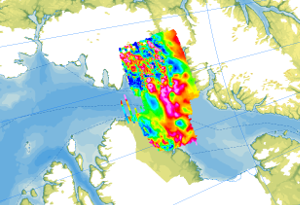
In May/June 2001, as part of the expedition NARES I, an aeromagnetic survey was carried out in the area of the eastern Kane Basin in cooperation with the Canadian GSC, in addition to the survey over the Robeson Channel and parallel to marine geophysical investigations with the Canadian icebreaker Louis S. St. Laurent. Another survey, NARES II, was conducted from Alexandra Fiord in 2003 and covered coastal areas of Ellesmere Island and the western Kane Basin. The aim of the research was to detect and localize the Wegener Fault, a transform fault between Ellesmere Island and NW Greenland, which is closely linked to the opening of the North Atlantic and the Arctic Ocean. The helicopter-borne magnetic surveys NARES I + II (Kane Basin) were carried out with a flight line spacing of 2 km, and control profiles were flown every 10 km. During the two expeditions, 11806 km of line data were collected (3573 km in 2001, and 8333 km in 2003), covering an area of approximately 20000 km². The aeromagnetic data were recorded by a magnetometer, which was towed approx. 25 m beneath the helicopter.
-
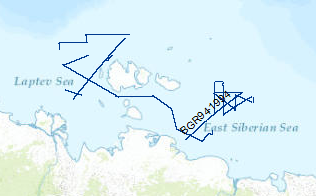
On the M/V Akademic Nemchinow multichannel seismic measurements were carried out on 34 lines with a total length of 4,000 km. The area covered was the Laptev Sea. The data format is Society of Exploration Geophysicists SEG Y.
-
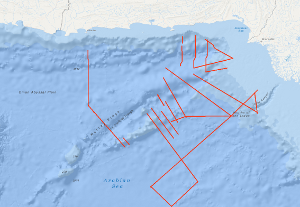
The Sonne Cruise SO122 was carried out by the Federal Institute for Geosciences and Natural Resources (BGR, Hannover) from 3rd August to 9th September 1997, in cooperation with GEOMAR (Kiel), the National Institute of Oceanography (NIO, Karachi) and the Hydrocarbon Development Institute of Pakistan (HDIP). During the joint project with R/V SONNE the Makran accretionary wedge off Pakistan should have been investigated in detail with multi-channel reflection seismics, magnetics and gravimetry. Intense fishery offshore Pakistan forced a change of the area of investigation to the south with the following objectives: investigation of the crustal structure and occurrence of the bottom simulating reflector (BSR) in the Makran accretionary wedge; investigation of the structure of the Murray Ridge System in order to reconstruct the geodynamic evolution of the eastern Indian Plate margin; determination of the origin of the crust underlying the Indus Fan and reconnaissance of the sedimentary history of the Indus Fan in order to reveal the uplift and erosion history of the Himalayas.