 My GeoNetwork catalogue
daily
Provided by
Type of resources
Available actions
Topics
Keywords
Contact for the resource
Update frequencies
Service types
-

Aerosol optical depth (AOD) as derived from TROPOMI observations. AOD describes the attenuation of the transmitted radiant power by the absence of aerosols. Attenuation can be caused by absorption and/or scattering. AOD is the primary parameter to evaluate the impact of aerosols on weather and climate. Daily AOD observations are binned onto a regular latitude-longitude grid. The TROPOMI instrument onboard the Copernicus SENTINEL-5 Precursor satellite is a nadir-viewing, imaging spectrometer that provides global measurements of atmospheric properties and constituents on a daily basis. It is contributing to monitoring air quality and climate, providing critical information to services and decision makers. The instrument uses passive remote sensing techniques by measuring the top of atmosphere solar radiation reflected by and radiated from the earth and its atmosphere. The four spectrometers of TROPOMI cover the ultraviolet (UV), visible (VIS), Near Infra-Red (NIR) and Short Wavelength Infra-Red (SWIR) domains of the electromagnetic spectrum. The operational trace gas products generated at DLR on behave ESA are: Ozone (O3), Nitrogen Dioxide (NO2), Sulfur Dioxide (SO2), Formaldehyde (HCHO), Carbon Monoxide (CO) and Methane (CH4), together with clouds and aerosol properties. This product is created in the scope of the project INPULS. It develops (a) innovative retrieval algorithms and processors for the generation of value-added products from the atmospheric Copernicus missions Sentinel-5 Precursor, Sentinel-4, and Sentinel-5, (b) cloud-based (re)processing systems, (c) improved data discovery and access technologies as well as server-side analytics for the users, and (d) data visualization services.
-

Daily updated and quality-controlled daily means of sea surface temperatures of the North Sea and Baltic Sea, derived from measurements of the Advanced Very High Resolution Radiometer Sensor (AVHRR sensor) during flyovers of different polar-orbiting satellites on the corresponding day.
-

The TROPOMI instrument onboard the Copernicus SENTINEL-5 Precursor satellite is a nadir-viewing, imaging spectrometer that provides global measurements of atmospheric properties and constituents on a daily basis. It is contributing to monitoring air quality and climate, providing critical information to services and decision makers. The instrument uses passive remote sensing techniques by measuring the top of atmosphere solar radiation reflected by and radiated from the earth and its atmosphere. The four spectrometers of TROPOMI cover the ultraviolet (UV), visible (VIS), Near Infra-Red (NIR) and Short Wavelength Infra-Red (SWIR) domains of the electromagnetic spectrum. The operational trace gas products generated at DLR on behave ESA are: Ozone (O3), Nitrogen Dioxide (NO2), Sulfur Dioxide (SO2), Formaldehyde (HCHO), Carbon Monoxide (CO) and Methane (CH4), together with clouds and aerosol properties. This product displays the Nitrogen Dioxide (NO2) near surface concentration for Germany and neighboring countries as derived from the POLYPHEMUS/DLR air quality model. Surface NO2 is mainly generated by anthropogenic sources, e.g. transport and industry. POLYPHEMUS/DLR is a state-of-the-art air quality model taking into consideration - meteorological conditions, - photochemistry, - anthropogenic and natural (biogenic) emissions, - TROPOMI NO2 observations for data assimilation. This Level 4 air quality product (surface NO2 at 15:00 UTC) is based on innovative algorithms, processors, data assimilation schemes and operational processing and dissemination chain developed in the framework of the INPULS project. The DLR project INPULS develops (a) innovative retrieval algorithms and processors for the generation of value-added products from the atmospheric Copernicus missions Sentinel-5 Precursor, Sentinel-4, and Sentinel-5, (b) cloud-based (re)processing systems, (c) improved data discovery and access technologies as well as server-side analytics for the users, and (d) data visualization services.
-
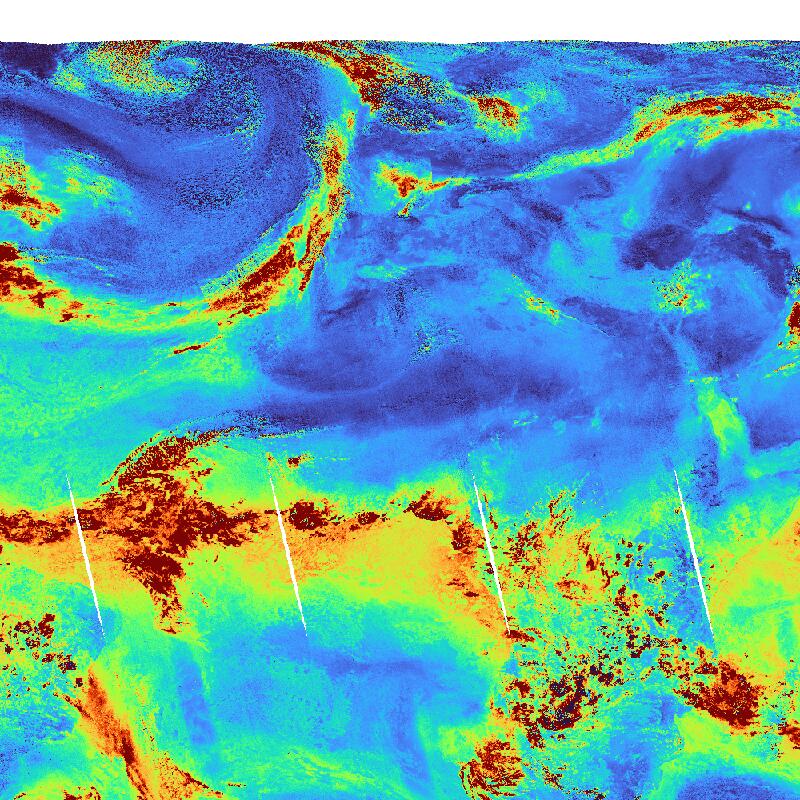
Water Vapour (H2O) concentration (globally) as derived from Sentinel-5P/TROPOMI observations. H2O is the most abundant greenhouse gas in the atmosphere. In addition it is one of the most powerful drivers for weather phenomena in the troposphere. Daily observations are binned onto a regular latitude-longitude grid. The TROPOMI instrument aboard the SENTINEL-5P space craft is a nadir-viewing, imaging spectrometer covering wavelength bands between the ultraviolet and the shortwave infra-red. TROPOMI's purpose is to measure atmospheric properties and constituents. It is contributing to monitoring air quality and providing critical information to services and decision makers. The instrument uses passive remote sensing techniques by measuring the Top Of Atmosphere (TOA) solar radiation reflected by and radiated from the earth and its atmosphere. The four spectrometers of TROPOMI cover the ultraviolet (UV), visible (VIS), Near Infra-Red (NIR) and Short Wavelength Infra-Red (SWIR) domains of the electromagnetic spectrum, allowing operational retrieval of the following trace gas constituents: Ozone (O3), Nitrogen Dioxide (NO2), Sulfur Dioxide (SO2), Water Vapour (H2O), Carbon Monoxide (CO) and Methane (CH4). Within the INPULS project, innovative algorithms and processors for the generation of Level 3 and Level 4 products, improved data discovery and access technologies as well as server-side analytics for the users are developed.
-
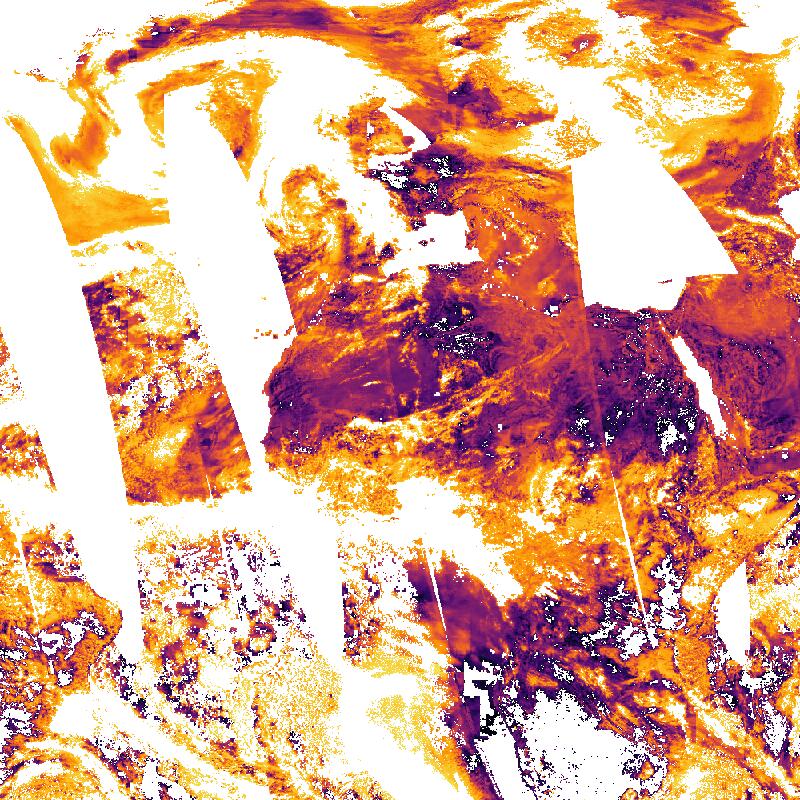
Aerosol single-scattering albedo (ASSA) as derived from TROPOMI observations. ASSA is a measure of how much light is scattered by aerosols compared to how much is absorbed. It is important for understanding the impact of aerosols on climate and radiative forcing. ASSA is unitless; a value of unity implies that extinction is completely due to scattering; conversely, a single-scattering albedo of zero implies that extinction is completely due to absorption. Daily ASSA observations are binned onto a regular latitude-longitude grid. The TROPOMI instrument onboard the Copernicus SENTINEL-5 Precursor satellite is a nadir-viewing, imaging spectrometer that provides global measurements of atmospheric properties and constituents on a daily basis. It is contributing to monitoring air quality and climate, providing critical information to services and decision makers. The instrument uses passive remote sensing techniques by measuring the top of atmosphere solar radiation reflected by and radiated from the earth and its atmosphere. The four spectrometers of TROPOMI cover the ultraviolet (UV), visible (VIS), Near Infra-Red (NIR) and Short Wavelength Infra-Red (SWIR) domains of the electromagnetic spectrum. The operational trace gas products generated at DLR on behave ESA are: Ozone (O3), Nitrogen Dioxide (NO2), Sulfur Dioxide (SO2), Formaldehyde (HCHO), Carbon Monoxide (CO) and Methane (CH4), together with clouds and aerosol properties. This product is created in the scope of the project INPULS. It develops (a) innovative retrieval algorithms and processors for the generation of value-added products from the atmospheric Copernicus missions Sentinel-5 Precursor, Sentinel-4, and Sentinel-5, (b) cloud-based (re)processing systems, (c) improved data discovery and access technologies as well as server-side analytics for the users, and (d) data visualization services.
-
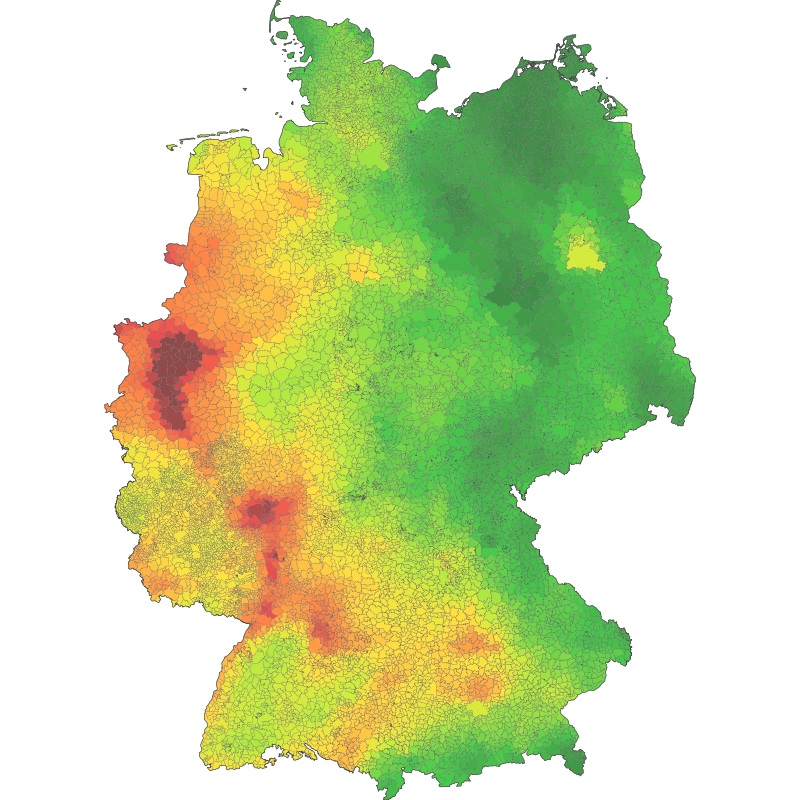
Air pollution and thermal stress are key environmental factors influencing human health. Information on their spatial and temporal dynamics is needed to support comprehensive exposure assessments and regional risk analysis. The dataset offers spatially aggregated bioclimatic and air quality related indicators for all districts in Germany. The datasets integrates information on air pollutat concentrations, the Aggregated Risk INdex (ARI) and the Universal Thermal Climate Index (UTCI). Hourly inputs from CAMS regional air quality analysis and forecast products as well as internally processed WRF simulations are processed in district-level daily means, maxima and minima enabling consistent and comparable characterization of environmental health risk across space and time. The dataset provide an important ressource for public health research and monitoring, climate impact studies, and regional decision-making, supporting improved understanding of how pollution and heat exposure evolve under changing climatic conditions.
-
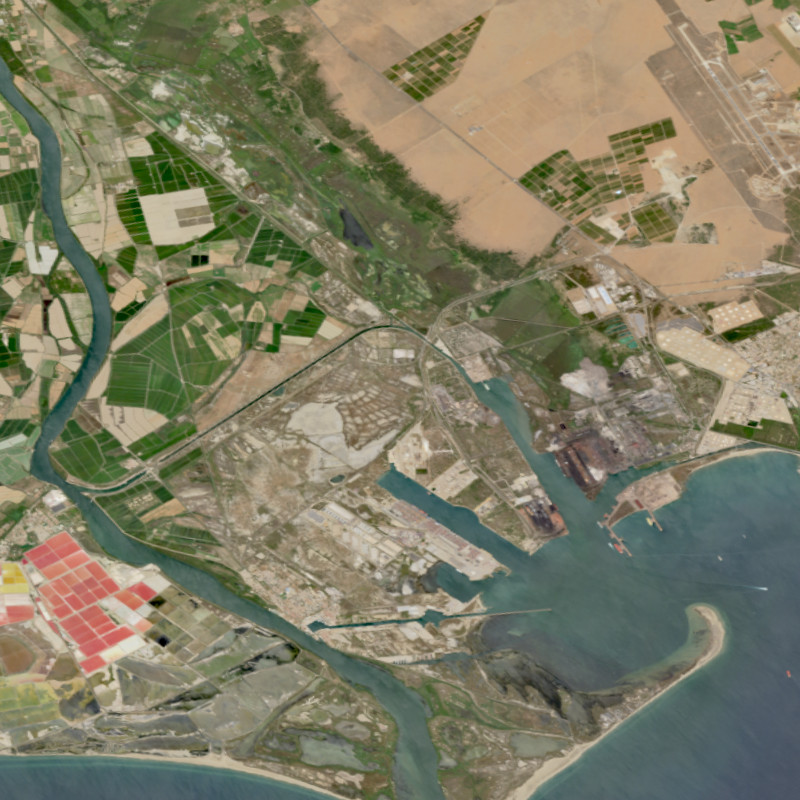
The EnMAP HSI L0 Quicklooks collection contains the VNIR and SWIR quicklook images as well as the quality masks for haze, cloud, or snow; based on the latest atmospheric correction methodology of the land processor. It allows users to get an overview which L0 data has been acquired and archived since the operational start of the EnMAP mission and which data is potentially available for on-demand processing into higher level products with specific processing parameters via the EOWEB-GeoPortal. The database is constantly updated with newly acquired L0 data. The Environmental Mapping and Analysis Program (EnMAP) is a German hyperspectral satellite mission that monitors and characterizes Earth’s environment on a global scale. EnMAP delivers accurate data that provides information on the status and evolution of terrestrial and aquatic ecosystems, supporting environmental monitoring, management, and decision-making. For more information, please see the mission website: https://www.enmap.org/mission/
-
-
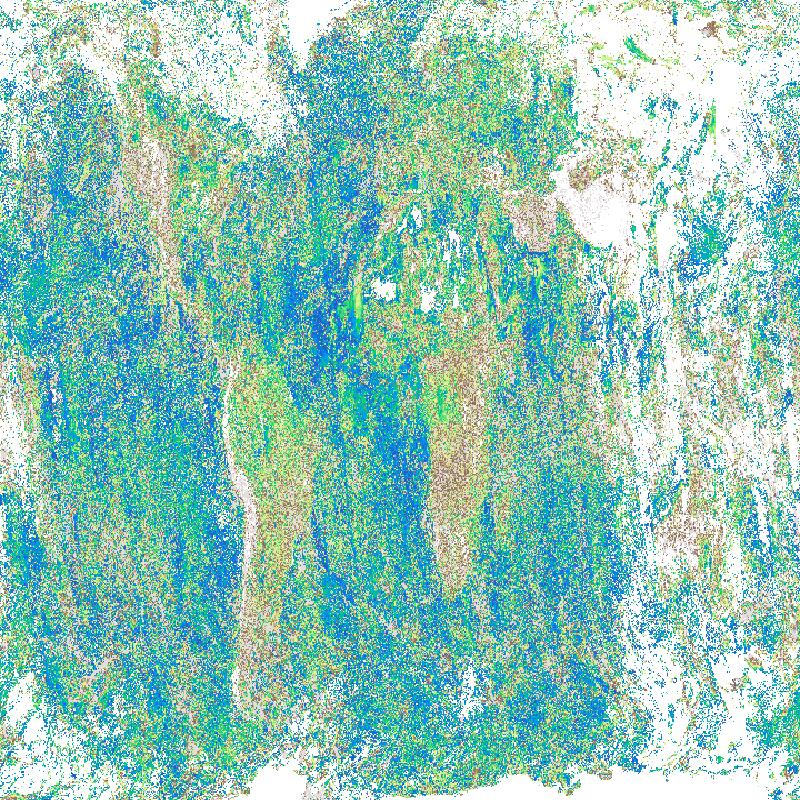
Aerosols are an indicator for episodic aerosol plumes from dust outbreaks, volcanic ash, and biomass burning. Daily observations are binned onto a regular latitude-longitude grid. The Aerosol layer height is provided in kilometres. The TROPOMI instrument onboard the Copernicus SENTINEL-5 Precursor satellite is a nadir-viewing, imaging spectrometer that provides global measurements of atmospheric properties and constituents on a daily basis. It is contributing to monitoring air quality and climate, providing critical information to services and decision makers. The instrument uses passive remote sensing techniques by measuring the top of atmosphere solar radiation reflected by and radiated from the earth and its atmosphere. The four spectrometers of TROPOMI cover the ultraviolet (UV), visible (VIS), Near Infra-Red (NIR) and Short Wavelength Infra-Red (SWIR) domains of the electromagnetic spectrum. The operational trace gas products generated at DLR on behave ESA are: Ozone (O3), Nitrogen Dioxide (NO2), Sulfur Dioxide (SO2), Formaldehyde (HCHO), Carbon Monoxide (CO) and Methane (CH4), together with clouds and aerosol properties. This product is created in the scope of the project INPULS. It develops (a) innovative retrieval algorithms and processors for the generation of value-added products from the atmospheric Copernicus missions Sentinel-5 Precursor, Sentinel-4, and Sentinel-5, (b) cloud-based (re)processing systems, (c) improved data discovery and access technologies as well as server-side analytics for the users, and (d) data visualization services.
-