 My GeoNetwork catalogue
Wirtschaft
Provided by
Type of resources
Available actions
Topics
Keywords
Contact for the resource
Update frequencies
Service types
-
Die Bodenrichtwerte und Bodenrichtwertzonen die in der Zuständigkeit der Stadt Velbert liegen, aufbereitet für die Präsentation im Geoportal.
-
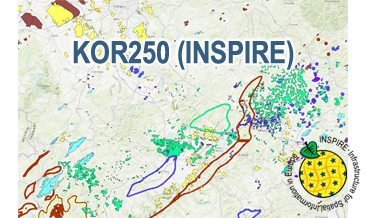
The WMS KOR250 (INSPIRE) in the scale of 1:250,000 shows occurrences and deposits of mineral resources in Germany, which lie close to the Earth’s surface, i.e. can be mined in open-pits, quarries or near-surface mines. These mineral resources include industrial minerals, aggregates, peat, lignite, oil shales, and natural brines. The map is derived from the KOR250, the digital successor of the map series KOR200 „Map of Near-Surface Deposits of the Federal Republic of Germany 1:200,000”, which has been published since 1984. The KOR200 and KOR250 have been published by the Federal Institute for Geosciences and Natural Resources together with the State Geological Surveys of the federal states on behalf of the Federal Ministry for Economic Affairs and Energy. Primary purpose of the KOR250 is to display Germany’s potential of domestic raw materials in a comparable way. The explanations given in the printed booklets accompanying the KOR200 are not available in the digital KOR250. In the KOR250 besides the defined deposits and differently coloured areas of raw materials, "active mines" (= operations) at time of publication or "focal points of several active mines" are marked with one symbol each. These mines are not included in the KOR250 (INSPIRE) as often the headquarters of the mining company and not the mining site itself is displayed as well as in many regions the dataset is outdated. As the map sheets of the KOR200 have been generated over more than three decades the timeliness of data is extremely different. For more detail, the current large-scale raw material maps of the Federal State Geological Surveys should always be consulted. The point data displayed in KOR250 (INSPIRE) indicate very small, but worth mentioning prospects of certain raw materials. The WMS KOR250 (INSPIRE) contains the two layers MR.MineralOccurence.Commodity.Polygon (mineral resources as polygons) and MR.MineralOccurence.Commodity.Point (mineral resources as points). Via the getFeatureInfo request the user obtains additional information on the mineral resources. Notes: The colouring of the raw material occurrences in the KOR250 (INSPIRE) largely corresponds to the colouring of the original KOR250. In the INSPIRE Data Specification on Mineral Resources (D2.8.III.21) there are no portrayal rules for building raw materials and dimension stones, which constitute a large part of the raw material occurrences. It should be noted that according to the INSPIRE commodity code list, most magmatites and metamorphites were assigned to the two values "granite" and "basalt". From a geological point of view and with regard to its origin, this assignment is often misleading. For more information on the outcropping rock of a specific raw material occurrence, the German name from the original KOR250 was mapped to the attribute name of the class GeologicFeature.
-
The KOR250 (INSPIRE) in the scale of 1:250,000 shows occurrences and deposits of mineral resources in Germany, which lie close to the Earth’s surface, i.e. can be mined in open-pits, quarries or near-surface mines. These mineral resources include industrial minerals, aggregates, peat, lignite, oil shales, and natural brines. The map is derived from the KOR250, the digital successor of the map series KOR200 „Map of Near-Surface Deposits of the Federal Republic of Germany 1:200,000”, which has been published since 1984. The KOR200 and KOR250 have been published by the Federal Institute for Geosciences and Natural Resources together with the State Geological Surveys of the federal states on behalf of the Federal Ministry for Economic Affairs and Energy. Primary purpose of the KOR250 is to display Germany’s potential of domestic raw materials in a comparable way. The explanations given in the printed booklets accompanying the KOR200 are not available in the digital KOR250. In the KOR250 besides the defined deposits and differently coloured areas of raw materials, "active mines" (= operations) at time of publication or "focal points of several active mines" are marked with one symbol each. These mines are not included in the KOR250 (INSPIRE) as often the headquarters of the mining company and not the mining site itself is displayed as well as in many regions the dataset is outdated. As the map sheets of the KOR200 have been generated over more than three decades the timeliness of data is extremely different. For more detail, the current large-scale raw material maps of the Federal State Geological Surveys should always be consulted. The point data displayed in KOR250 (INSPIRE) indicate very small, but worth mentioning prospects of certain raw materials. According to the Data Specification on Mineral Resources (D2.8.III.21) the content of the map is stored in two INSPIRE-compliant GML files: KOR250_EarthResource_polygon.gml comprises the mineral resources as polygons. KOR250_EarthResource_point.gml comprises the mineral resources as points. The GML files together with a Readme.txt file are provided in ZIP format (KOR250-INSPIRE.zip). The Readme.text file (German/English) contains detailed information on the GML files content. Data transformation was proceeded by using the INSPIRE Solution Pack for FME according to the INSPIRE requirements. Notes: It should be noted that according to the INSPIRE commodity code list, most magmatites and metamorphites were assigned to the two values "granite" and "basalt". From a geological point of view and with regard to its origin, this assignment is often misleading. For more information on the outcropping rock of a specific raw material occurrence, the German name from the original KOR250 was mapped to the attribute name of the class GeologicFeature.
-
Überwachungsprogramm der IED-Anlagen des Saarlandes im Zuständigkeitsbereich des Bergamtes Saarbrücken (BAS). Die Daten wurden aus dem Feature Kraftwerke von Bergbau nach der im Anhang befindlichen Angaben selektiert. Die europäische Industrieemissionsrichtlinie (abgekürzt IED für „Industrial Emissions Directive 2010/75/EU) legt Genehmigungs- und Überwachungsstandards für besonders umweltrelevante Industrieanlagen fest
-
Bruchspalten -Geländerisse die durch horizontales Zerreisen des Schichtverbandes unter Einwirkung endogener Kräfte entstanden sind. Tagesbrüche: Ein bergbaubedingter Tagesbruch ist der direkte Einbruch der überdeckenden Gebirgs- und Bodenschichten in einen unverfüllten bergmännischen Hohlraum in geringer Tiefe
-
Betriebe unter Bergaufsicht, Besucherbergwerke im Saarland, Bundesberggesetz (BBergG)
-
Wärmedichte Wohnen 2016 (EBF): Aktueller Wärmebedarf der Wohngebäude, bezogen auf die Energiebezugsfläche (beheizte Wohnfläche) der Wohngebäude in kWh/(m²*a).
-
Wärmebedarf Wohnen 2035: Prognostizierter Wärmebedarf der Wohngebäude für das Jahr 2035, aggregiert auf die Quartiersfläche in MWh/a: In Rücksprache mit einem Expertengremium wurde der künftige Wohngebäudewärmebedarf innerhalb der dargestellten Siedlungsgebiete abgeschätzt. Berücksichtigt wurden die Entwicklung der Bevölkerung und der Pro-Kopf-Wohnfläche (auf kommunaler Ebene). Zudem wurde für jeden Siedlungstyp eine individuelle Sanierungswahrscheinlichkeit festgelegt, die die Erfahrungen im Saarland der letzten Jahre widerspiegelt.
-
Wärmedichte Nicht-Wohnen (QF): Aktueller Wärmebedarf der Nicht-Wohngebäude, bezogen auf die Quartiersfläche in kWh/(m²*a).
-
Betriebe unter Bergaufsicht im Saarland, Tagebaue - Quarzsand, Betriebsflächen und Abbauflächen, Bundesberggesetz (BBergG)