 My GeoNetwork catalogue
Regional
Provided by
Type of resources
Available actions
Topics
Keywords
Contact for the resource
Update frequencies
Service types
-
-- Customize this sample record to describe the Catalogue Service Web (CSW) service of your catalogue --. See https://docs.geonetwork-opensource.org/4.4/administrator-guide/configuring-the-catalog/csw-configuration/ Access datasets, maps and services from my organisation using the OGC CSW standards. This catalogue contains descriptions of GIS resources on the ... region produced and/or maintained by ....
-

Water Permeability (hydraulic conducivity) is an important soil physical property describing the speed at which water moves through a fully saturated soil. Hydraulic conductivity values (kf values) as shown in this dataset are added up for all soil horizons down to 1 m below the surface. They are then classified into six groups ranging from very low to extremely high. For mineral soils, kf values are computed by pedotransfer functions using soil texture type, humus content and effective packing density information. These input parameter are themselves estimates made by soil surveyors in the field from soil material collected using soil augers.
-

Soil erodibility expresses how susceptible a soil is of being eroded by water. To quantify that risk the K-factor of the German implementation (ABAG) of the Universal Soil Loss Equation (USLE) is used. The K-factor as shown in this dataset is classified into groups ranging from very low to very high. K-factor values are derived from lookup tables based on classes of soil texture. They are subsequently corrected depending on the stoniness of a soil and its humus content. The input parameter are themselves estimates made by soil surveyors in the field from soil material collected using soil augers. Note that the K-factor is only calculated for agricultural soils and solely represents topsoil horizons.
-

The potential cation exchange capacity is a measure of a soils ability to store ions which are positively charged. Cation exchange capacity as shown in this dataset is added up for all soil horizons down to 1 m below the surface and later classified into groups ranging from very low to very high. For mineral soils, cation exchange capacity values are computed by pedotransfer functions using clay and silt percentages derived from soil texture classes as well as humus content. The input parameter are themselves estimates made by soil surveyors in the field from soil material collected using soil augers.
-

Plant available water capacity, also known as available water-holding capacity, is a key soil attribute as it quantifies the amount of a soil's water available for plants. More precisely, the available water-holding capacity is defined as the amount of water held by soil mesopores, i.e. between field capacity (pF 1.8) and permanent wilting point (pF 4.2). Plant available water capacity as shown in this dataset is added up for all soil horizons down to 1 m below the surface and later classified into groups ranging from very low to very high. For mineral soils, plant available water capacity values are computed by pedotransfer functions using soil texture type, humus content and effective packing density information. Share of coarse fragments and hard rock are considered as non-water holding volume. The input parameter are themselves estimates made by soil surveyors in the field from soil material collected using soil augers.
-

Das Feature Types Soil Body umfasst die weiteren feature Types Derived Soil Profile und Soil Horizon
-

The field capacity of a soil specifies the amount of water that remains in the soil after gravity has drained all excess water following, for instance, a major rain event. It is defined as the water content of a soil at pF 1.8. Water content at field capacity as shown in this dataset is added up for all soil horizons down to 1 m below the surface and later classified into groups ranging from very low to very high. For mineral soils, field capacity values are computed by pedotransfer functions using soil texture type, humus content and effective packing density information. Share of coarse fragments and hard rock are considered as non-water holding volume. The input parameter are themselves estimates made by soil surveyors in the field from soil material collected using soil augers.
-
Das Feature Types Soil Body umfasst die weiteren feature Types Derived Soil Profile und Soil Horizon
-
Verlauf aller Straßen und Wege, die einen Namen haben innerhalb und teilweise auch außerhalb der Stadt Göttingen. Die Information wird in einer Linie gespeichert. Namenlose Wege und kleine Verbindungswege sind nicht enthalten.
-
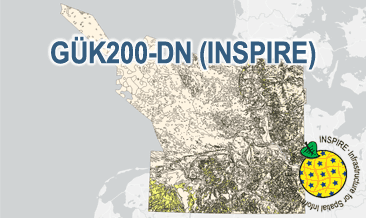
The General Geological Map of the Federal Republic of Germany 1:200,000 (GÜK200) provides detailed information on the stratigraphy, petrography and genesis of the geological units shown. In this revised GÜK200-DN, the onshore surface geology is shown in up to two overlays. The thin overlying soil is not shown. In the marine environment, only the petrography of the recent seabed is shown, which comprises the uppermost 20 cm of the seabed. In accordance with the original GÜK200 map sheets, the seabed is referred to stratigraphically as the recent seabed. According to the Data Specification on Geology (D2.8.II.4_v3.0) the geological map provides INSPIRE-compliant data. A base layer and two overlay layers are displayed correspondingly to the INSPIRE portrayal rules. The geologic units are represented graphically by stratigraphy (GE.GeologicUnit.BaseLayer.AgeOfRocks, GE.GeologicUnit.OverlayLayer1.AgeOfRocks, and GE.GeologicUnit.OverlayLayer2.AgeOfRocks) and lithology (GE.GeologicUnit.BaseLayer.Lithology, GE.GeologicUnit.OverlayLayer1.Lithology, and GE.GeologicUnit.OverlayLayer2.Lithology). The user obtains detailed information via the getFeatureInfo request on the lithology, stratigraphy (age) and genesis (event environment and event process).